Table of Contents
“Lord, Lord!” — Was it not so?
In Matt. 7:22–23 we read of people who will one day stand before the Lord and appeal to the works they did in His Name. Yet He will say to them: “I never knew you; depart from Me, you who practise lawlessness!” (Matt. 7:23).
In Matt. 22:11–12 we read how the king comes in among the wedding guests and notices a man who is not wearing a wedding garment. He asks him: “Friend, how did you come in here without a wedding garment?” And the man “was speechless” (Matt. 22:12).
Both passages contain a serious warning: our religious confession, the works to which we appeal, and our own claims are not enough to prove that we are ready to stand before God.
The Word also warns us that the Lord Jesus will be revealed from heaven “in flaming fire, taking vengeance on them that know not God, and that obey not the gospel of our Lord Jesus Christ” (2 Thess. 1:8).
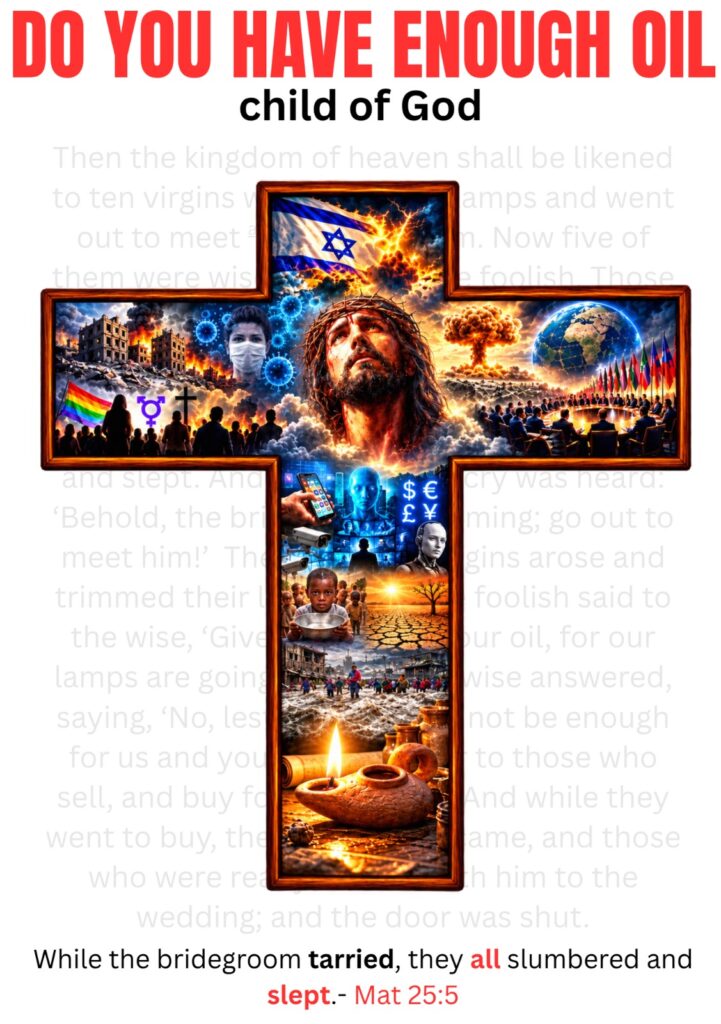
Child of God — do you have enough oil? (Matt. 25:1–13). Is your garment clean and pure? Have you honestly examined yourself before the Word of God? Are you ready to stand before Him?
The purpose of Jesus
When Jesus died on the cross, the veil was torn and the way to God was opened in a new way (Matt. 27:51; Heb. 10:19–22). Jesus made the way for a lost world to be reconciled to God. But do not think that you are ready to stand before God with an unrepentant heart and a life in which you deliberately cling to sin. Jesus did not shed His precious blood so that we could continue living in sin. He came to save us from our sins and call us to a new life (Matt. 1:21; Titus 2:14). Whoever sets his hope on Him purifies himself, just as He is pure (1 John 3:3).
Jesus’ coming, His walk, His suffering, His death and His resurrection were not an excuse to sin again and again and merely ask for forgiveness once more without repenting. The Word says: “If we confess our sins, he is faithful and just to forgive us our sins, and to cleanse us from all unrighteousness” (1 John 1:9). But that same Word warns us not to continue in sin so that grace may abound: “God forbid!” (Rom. 6:1–2). Jesus destroyed the works of the devil (1 John 3:8), conquered death through His victory (1 Cor. 15:54–57), and opened the way to God through His sacrifice (Heb. 10:19–22). Therefore, we must resist sin seriously and fight against it (Heb. 12:4).
Our sins form a dividing wall between us and God (Isa. 59:2). If you show no growth in holiness and have no desire to resist sin, you must examine yourself before God. There is a danger that a person may have only a form of godliness while denying its power (2 Tim. 3:5). The Word calls us to pursue holiness, “without which no man shall see the Lord” (Heb. 12:14). Do not be satisfied with an outward form of religion while your heart is far from God.
If your religion does not teach you to take up your cross, deny yourself and follow Jesus, you must ask what your faith is truly built upon. Jesus said that anyone who wants to follow Him must deny himself, take up his cross and follow Him (Matt. 16:24). How can you testify to the gospel, to Jesus’ victory and His resurrection, if you are not willing to fight against sin and live a life that bears fruit in keeping with repentance? Jesus Himself said: “By their fruits ye shall know them” (Matt. 7:16).
Jesus also said: “For whosoever will save his life shall lose it: and whosoever will lose his life for my sake shall find it” (Matt. 10:39). Following Jesus requires more than words, religious knowledge or church attendance. It requires that we put Him above ourselves and be willing to submit our own will to Him.
Child of God — are you occupied with the things of the world, or are you preparing to meet the Lord? Is your heart set on Him, or are you trying to serve both God and the world at the same time? James warns about the double-minded person who is unstable in all his ways (James 1:8). The Word also says: “Love not the world, neither the things that are in the world” (1 John 2:15). Examine yourself honestly before God. Do not rely on a religious name or a doctrine. Seek the Lord, submit to His Word and walk in obedience to Him.
Child of God
Many people say they are children of God and often quote John 1:12. They say they have received Jesus and believed in Him; therefore, they believe they are children of God. But is that all the passage says? Belonging to a church, growing up in a Christian home or having been baptised as a child is not, in itself, proof that you have been born again. Jesus said that a person must be born again (John 3:3). Romans 8:14 says: “For as many as are led by the Spirit of God, they are the sons of God.” Where is the Spirit of God leading you? Is He leading you away from sin and towards a life of obedience to God?
1 John 1:7 says: “But if we walk in the light, as he is in the light, we have fellowship one with another, and the blood of Jesus Christ his Son cleanseth us from all sin.” We must now walk in the light and examine our lives before God. Paul warns in 1 Corinthians 11:31–32 that we should judge ourselves, so that we will not be condemned with the world. God rebukes and disciplines those He loves and calls them to repent (Rev. 3:19). Jesus gave Himself to redeem us from all iniquity and purify for Himself a people who are zealous for good works (Titus 2:14). Do you realise that this life is like a tent-dwelling? (2 Cor. 5:1). Do not put off examining your spiritual condition until tomorrow.
If you are not willing now to hear the Lord’s voice through His Word and examine what still stands between you and Him, how will you recognise the warnings when He comes? In the days of Lot, his sons-in-law-to-be regarded his warning as a joke and did not take it seriously (Gen. 19:14). Jesus also warned people who could discern the signs of the weather but not the time in which they were living (Luke 12:54–56). Child of God, do you have enough oil? Are you watchful and ready to meet the Bridegroom? (Matt. 25:1–13).
Repentance
All have sinned (Rom. 3:23), and the wages of sin is death (Rom. 6:23). God desires all people to be saved and to come to the knowledge of the truth (1 Tim. 2:4). If you call upon the Name of the Lord, you will be saved (Rom. 10:13). Jesus says: “Behold, I stand at the door, and knock: if any man hear my voice, and open the door, I will come in to him, and will sup with him, and he with me” (Rev. 3:20). Will you heed His voice and open your heart to Him?
Many people do not heed this call and thereby harden their hearts. But God does not stop addressing people. Job 33:14–30 describes how God warns people in different ways and can turn them back from destruction. Sometimes difficult circumstances can lead us to examine ourselves, but we should not wait for a crisis before heeding God’s call. If you hear His voice, do not harden your heart. Turn to Him, acknowledge your sin, and receive Jesus Christ as your Saviour and Redeemer.
Sadly, many people still do not heed the call, but harden their hearts even more (Heb. 3:15). We must acknowledge our need for God’s salvation and turn to Him. The Holy Spirit convicts people of sin and leads them into the truth (John 16:8, 13). Do not ignore the conviction of sin or postpone the decision to turn to God.
When you repent and turn to God, you must turn your back on sin, confess your sins and follow Jesus with your whole life. Jesus said that anyone who wants to follow Him must be willing to give up everything that prevents him from putting the Lord first (Luke 14:33). This is a step of faith in which you entrust your life to Him without knowing what the future holds. You submit to His Word and allow the Holy Spirit to work in you and lead you into a personal relationship with Jesus Christ.
Born Again
After you repent and turn to God and sincerely confess your sins, God works in your life through His mercy and causes you to be born again through the Holy Spirit (Titus 3:5). The new birth is God’s work in you, not something you obtain through your own merit. Jesus said that a person must be born again (John 3:3–8). Many people expect a special feeling or a dramatic experience, but the new birth cannot be measured by emotions alone. God works in each person’s life in His own way. Jesus said: “Peace I leave with you, my peace I give unto you” (John 14:27). Our trust must rest in Him and His Word, not merely in how we felt at a particular moment.
After the new birth, a new life begins. Things such as smoking, drunkenness, fornication, dishonesty, fighting and stealing must no longer be regarded as acceptable parts of your life. God calls us to turn away from sin and walk in obedience to Him. The Word says: “Therefore if any man be in Christ, he is a new creature: old things are passed away; behold, all things are become new” (2 Cor. 5:17). This change does not mean that every habit will necessarily disappear immediately or that a believer will never stumble again. It means that your life is now under the lordship of Christ and that you must grow in holiness. Even your attitude towards other people should change. The Word calls us to do good to people, even to our enemies (Rom. 12:20).
In my own life, the new birth was a profound experience. I had read the Bible before, but I did not understand it as I did after my new birth. Then the Word opened up to me, and I experienced a change in my heart and desires. This is my testimony of what God did in me. Your experience does not have to be exactly like mine, but the new birth is not merely a label, a church affiliation or a religious tradition. Scripture calls us to examine our faith and see whether we truly stand in the faith (2 Cor. 13:5). John also writes that we can know that we know Him if we keep His commandments (1 John 2:3).
Therefore, do not rely merely on a memory, a feeling or a religious experience. Examine your life before God. Is there a genuine desire to know Him, obey His Word and turn away from sin? The new birth is God’s work through His Spirit, and the new life should bear fruit over time. Seek the Lord sincerely, remain in His Word and allow the Holy Spirit to lead you. The question is not whether you can describe a particular experience, but whether your faith in Jesus Christ is real and whether your life shows the fruit of someone who belongs to Him.
Deception
After the new birth, this is an important time in a Christian’s life. You are like a sponge wanting to absorb new information, but you must learn to test everything against the Word of God. Your spirit has awakened, but you are still growing in the truth. Therefore, Scripture warns us to remain watchful and not be carried away by every new teaching (1 Pet. 2:2; Eph. 4:14; 1 John 4:1).
Satan will try to distract you from what you ought to be doing. He can even present deception under the banner of Christianity, for the devil transforms himself into an angel of light, and his ministers as ministers of righteousness (2 Cor. 11:14–15).
Jesus says that people love darkness rather than light because their deeds are evil; they do not come to the light lest their deeds should be exposed (John 3:19–21). This warning should also lead us to examine whether our messages and teachings truly lead people into the light of God’s Word, or rather help them avoid facing their sin.
Prosperity theology can seem attractive when presented as Christianity. Some teachings give the impression that Christians can claim worldly wealth, health and success, as though God had promised to bless every believer with these things. But Scripture teaches us to lay up treasures in heaven and warns that the love of money can draw us away from the truth (Matt. 6:19–21; 1 Tim. 6:5–10). Our blessings in Christ are not a guarantee of worldly prosperity (Eph. 1:3).
Christian music can deeply affect people, but an emotional experience is not, in itself, proof that the Holy Spirit is truly at work. Jesus teaches that the Holy Spirit will convict the world of sin, righteousness and judgment and lead His disciples into the truth (John 16:8, 13). The question is therefore not merely how strongly we feel something, but whether we are led by the truth of God’s Word to repentance, obedience and a changed life.
Scripture also warns against a world system that draws people away from God. Revelation calls God’s people to come out of Babylon so that they will not share in her sins (Rev. 18:3–4). We must be careful not to apply this image lightly to a particular group; nevertheless, the warning itself is clear: God’s children must not identify themselves with sin and worldly values.
Christians can also become occupied with positive thinking and goal-oriented courses. Such tools are not necessarily wrong, but they become dangerous when they take the place of the gospel—when much is said about success and self-improvement, but little about sin, repentance, self-denial and the cross. Jesus said that anyone who wants to follow Him must deny himself and take up his cross (Matt. 16:24). We must not build up the self where the Lord calls us to crucify it (Gal. 2:20).
When the message of salvation through Jesus Christ, repentance and a holy life is pushed into the background, while the main emphasis falls on personal rights, self-fulfilment and worldly success, we must ask whether we are still hearing the whole counsel of God.
John warns us not to love the world or the things that are in the world, for the desires of the world pass away, but whoever does the will of God abides for ever (1 John 2:15–17). This does not mean that every aspect of society is wrong; it means that we must not embrace values and desires that stand against God’s will.
The danger is that we may think we are spiritually rich while in reality we are blind to our own condition. Jesus warns the church in Laodicea: they say that they are rich and have need of nothing, but do not realise how wretched, poor, blind and naked they are. He calls them to recognise their condition, become zealous and repent (Rev. 3:14–22).
Child of God, do not assume that something is true merely because it is presented as Christianity. Test everything against the Word of God. Allow the Holy Spirit to convict you of sin, lead you into the truth and bring you closer to Jesus and the cross.
Sanctification
When you confess your sins and forsake them, the Holy Spirit will continue to lead you after the new birth. Your next step is to come to the point where you surrender yourself completely to God and die to self and conformity to the world (Rom. 12:1–2). As Paul testifies: “I live; yet not I, but Christ liveth in me” (Gal. 2:20).
God wants to use you to help others, but you must personally know the salvation found in Jesus Christ and allow His work to become visible in your life. All who have been baptised into Christ Jesus have been baptised into His death (Rom. 6:3). Baptism is one of the important foundations of a holy and victorious Christian life. Yet many people do not understand where baptism fits in. Some were baptised as children, without being able themselves to understand the meaning of this confession. Others were baptised as adults but never truly came to the new birth.
In baptism, after true new birth, you openly confess that you identify with Christ’s death and resurrection and no longer wish to live for yourself, but for Him (Rom. 6:3–4; Col. 2:11–12). This is a serious confession of your commitment to the Lord and must not be taken lightly. Over many years, I have observed that believers who took this step often remained more steadfast when trials and persecution came. Baptism does not replace faith and obedience, but neither should we treat its significance lightly.
The Holy Spirit will lead you closer to the light, so that sins such as hatred, bitterness, unforgiveness, gossip, swearing, sowing discord, irritability, lies and other sinful habits can be dealt with. As you put these things away and learn to overcome them, you become more and more like Jesus.
These are not works that make you righteous. We are saved by grace through faith, not by works; yet we are created in Christ to do good works (Eph. 2:8–10). True faith does not remain without fruit. James warns that faith without works is dead (James 2:14–17). Good works do not earn your salvation, but they should be the fruit of your faith and your new life in Christ.
When you surrender yourself completely to God, submit your own will and pride to Him, and place everything on the altar, He can do a deeper work in your heart. Paul prays that God will sanctify us completely and preserve our spirit, soul and body blameless until the coming of Jesus Christ (1 Thess. 5:23–24). This is not merely a matter of outward behaviour; God wants to change you inwardly so that you stand stronger against temptation and increasingly live in righteousness (Rom. 6:22).
When you are truly born again and decide to walk the narrow path with Jesus, you may discover that your old worldly friends no longer want to stand with you. Things you once laughed about, did and talked about together no longer fit the new life you have received in Christ. Peter warns that people may be surprised when you no longer join them in the same worldly way of life, and that they may speak evil of you (1 Pet. 4:3–4). Jesus already warned us that the world would hate His followers because they no longer belong to the world (John 15:18–19).
Jesus warns that the gate is narrow and the way is difficult that leads to life, and few find it (Matt. 7:13–14). When someone asked Him whether few would be saved, Jesus answered that we must strive to enter through the narrow door, for many will try to enter and will not be able (Luke 13:23–24). He also warns that many will say on that day, “Lord, Lord,” but He will declare that He never knew them (Matt. 7:21–23).
This is a serious warning to everyone who professes to belong to Christ. It is not enough merely to carry a Christian name or do religious things. We must examine ourselves before God and make sure that we truly know Him, submit ourselves to Him and that our lives bear the fruit of genuine faith.
Sadly, many people remain in a Christianity of falling and rising again, without the fruit and steadfastness to which the Lord calls them. Jesus commanded us to make disciples and teach them to observe all that He commanded (Matt. 28:19–20). The question is therefore not merely whether we call ourselves Christians, but whether we truly belong to Christ and follow Him.
Opposition
Three things strongly oppose you on the narrow, lonely path that leads to the cross.
- Your flesh — It tends to return to the world and its desires. But when you walk in the Spirit and trust in the Lord, He helps you resist the flesh and gain the victory (Gal. 5:16–17; Rom. 8:13).
- The devil — He continually tries to tempt you and attack your thoughts. Therefore, the Word warns you to be watchful, resist the devil and put on the whole armour of God. Through the Lord’s strength, you can stand firm (1 Pet. 5:8–9; Eph. 6:11–18).
- Lukewarm Christians — They may continually offer you a cheaper Jesus, a version of Christianity in which repentance, self-denial and sanctification are pushed into the background. This is a serious danger, because they can draw you away from the truth and make you believe you are on the right path while you are actually straying from it. No one else can replace your personal obedience, faith and perseverance. You must hold fast to the Lord yourself in faith and contend for the faith once delivered to the saints (Jude 1:3).
Jesus warns the lukewarm church in Laodicea that He will spew them out of His mouth (Rev. 3:15–16). They thought they were rich and lacked nothing, but they did not recognise their true spiritual condition. Jesus calls them to repent (Rev. 3:17–19).
Many believers can be misled by the influence of lukewarm Christians and begin to fall back. Therefore, remain watchful, test everything against the Word of God and do not allow another person’s watered-down Christianity to draw you away from the narrow path (Matt. 7:13–14; 1 John 4:1).
The danger
The deception is so subtle because the devil transforms himself into an angel of light (2 Cor. 11:14). He can even present deception under the banner of Christianity. If you do not allow the Holy Spirit to lead you further into a life of complete surrender to God, you are in great danger of being swept along and deceived by lukewarm, worldly Christianity. Jesus’ warning to the church in Laodicea should make us think seriously about our own spiritual condition (Rev. 3:14–22).
Remember, your sins grieve the Holy Spirit (Eph. 4:30), and the Word warns you not to quench Him (1 Thess. 5:19). Do not keep ignoring His warnings and hardening your heart against the truth. Paul warns us to test everything and hold fast to what is good (1 Thess. 5:19–22).
Jesus Himself said that we must strive to enter through the narrow door, for many will try to enter and will not be able (Luke 13:24). He also warns that the gate is narrow and the way is difficult that leads to life, and few find it (Matt. 7:13–14). Do not assume you are ready merely because you call yourself a Christian.
Paul warns Timothy to take heed to himself and to his teaching and to continue in them (1 Tim. 4:16). He also writes: “If we be dead with him, we shall also live with him” (2 Tim. 2:11). The message of the cross is foolishness to those who are perishing, but to us who are being saved it is the power of God (1 Cor. 1:18). The cross does not call us to a comfortable, worldly Christianity, but to a life in which we deny ourselves and follow Jesus.
Remember: all who desire to live godly in Christ Jesus will suffer persecution (2 Tim. 3:12). God’s approval is not measured by worldly riches or material prosperity. Do not accept a message that makes you believe Christianity will necessarily guarantee worldly success.
Beware of consumer-friendly religion that pleases people but waters down the truth. Paul warns against another Jesus, another gospel and another spirit (2 Cor. 11:3–4). When repentance, the cross, obedience and sanctification are pushed into the background to satisfy people’s desires, we must return to the Word of God and test everything by it.
God also warns us in 2 Thessalonians 2:9–12 about those who perish because they did not receive the love of the truth, that they might be saved. Therefore, God gives them over to delusion, so that they believe the lie. Do not deliberately reject the truth and think that you will always be able to return to it easily later.
Scripture warns us seriously about a hardened heart and falling away (Heb. 3:12–13; 6:4–6). God’s grace must never be used as an excuse for persistent disobedience. Take His Word seriously, listen to the Holy Spirit and persevere in the faith.
Child of God, examine your heart. Do you truly stand firm in the truth, or are you being swept along by a form of Christianity that soothes your conscience but does not lead you to the cross? Do not take the warnings of God’s Word lightly. Persevere in Christ, test everything by Scripture and remain watchful.
Warning – Do you see the signs of the times?
(Luke 21:28)
Thousands of years ago, God declared that He makes known the end from the beginning (Isa. 46:9–10). The things that happened to Israel were recorded as warnings and examples for us, upon whom the ends of the ages have come (1 Cor. 10:11).
Jesus says in Matt. 25:1–13 that the kingdom of heaven will be like ten virgins—as the KJV translation puts it. Not merely little girls as other translations, but virgins. Words matter when we read God’s Word. We should not simply assume that a newer translation is necessarily a better rendering. We must examine Scripture for ourselves and determine whether its message has been faithfully conveyed.
The Bereans even tested the preaching they heard against the Scriptures (Acts 17:11). How much more should we examine the Word for ourselves?
While the bridegroom delayed his coming, ALL became drowsy and fell asleep. But at midnight there was a cry:
Behold, the bridegroom is coming! Go out to meet him!
Only five were wise—they had enough oil—and five were foolish, because they were not prepared.
When the bridegroom came, the wise were ready and went in with him to the wedding feast. And the door was shut.
Where do you stand today, child of God? Do you have enough oil? Are you ready to meet your Bridegroom?